642 review comments across 121 changed files in one pull request
#139596A clearer starting point for engineering decisions
Beyond
The Alignment
Read the work before
you commit the quarter.
Beyond The Alignment organizes your GitHub work record into source-linked signals, open questions, and planning implications for migrations, upgrades, and platform initiatives. Your team adds the context and makes the decision.
Like financial analysis, BTA does not create a new record. It organizes the record you already have so patterns, exceptions, and unresolved questions are easier to see and act on.
Runs locallyLinks to sourcesUses your endpoint
IssuesPull requestsReviewsReleasesPlanning questions
From source to findingSee how the work
See how the work
becomes evidence.
BTA reads the work in context, highlights the part that matters, and connects it to a finding your team can inspect and question.
Reading the public work recordReady to read 3 sources
Organized evidence3 source-backed findings
Review effort concentrates
Have we reserved enough reviewer capacity?
Source #139596Ownership crosses team boundaries
Who needs to be involved before the plan hardens?
Source #136589Verification continues after merge
Which checks and follow-ups need named owners?
Source #139069Representative sources from the published Kubernetes initiative-readiness analysis.
The repository gives you a starting point. Your team fills in the context it cannot see.
BTA / PUBLIC ANALYSIS EXCERPTNext.js / Migration readiness08 SEP 2026
What needs attention
before we upgrade?
3,114 work items131 release recordsJun – Aug 2026
What we foundWhat to ask nextSource
Team context needed
How your architecture, customers, and rollout policy change the risk.
Next planning moves
Choose what to reproduce, monitor, sequence, or set aside.
A shared starting point for the meeting before the commitment.See the method
For the decisions
you want to get right.
- Migrations & upgrades
- Platform initiatives
- Roadmap commitments
- Proceed, defer, or watch
Bring the work record
into the room.
BTA does the heavy reading so your team can spend its time testing assumptions, adding context, and deciding what to do.
- 1
Read the work record
Gather the issues, pull requests, reviews, releases, comments, and changes relevant to the decision.
- 2
Surface what matters
Look for recurring friction, concentrated review, open work, follow-up after merge, and the questions the record cannot answer.
- 3
Bring it to the team
Share the findings and sources with the people who understand the architecture, history, constraints, and customers.
BTA does the heavy reading. Your team brings the context and makes the call.
It is more than another place
to ask a question.
The model is only part of the system.
The real value is knowing what to read, what to connect, and which questions to bring back to the team.
GitHub & Jira
Preserve the work record and support day-to-day execution.
General AI
Helps investigate the material and questions you provide.
Beyond The Alignment
Applies a planning method to what the evidence supports and what the team still needs to answer.
See the work behind
the conclusion.
We analyzed 14,518 work items across two public repositories and published the evidence so you can judge the method for yourself.
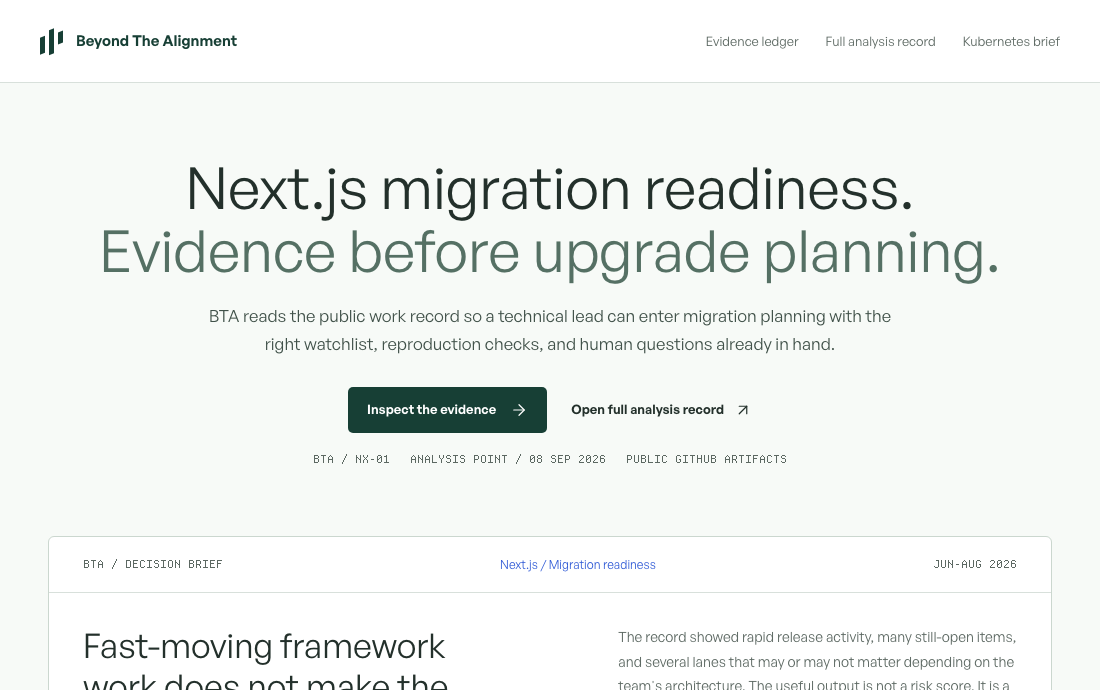
Next.js migration readiness
18 stable releases, 113 prereleases, and 891 still-open work items. Which unresolved issues resemble your application closely enough to reproduce or monitor?
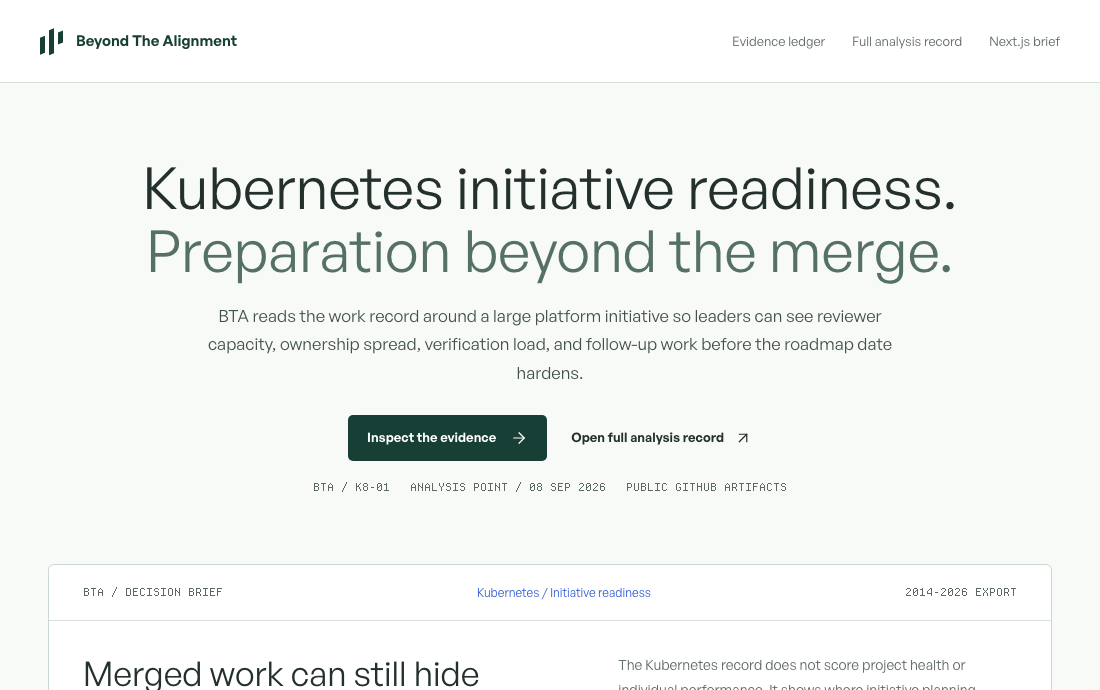
Kubernetes initiative readiness
1,974 review comments across a 14-PR record, including one PR with 642 comments across 121 files. Are review capacity, ownership, verification, and follow-up prepared?
Keep control of
where it runs.
Run BTA in your environment with Docker or Helm. Connect GitHub or GitHub Enterprise, and keep the repository collection, analysis state, and cache with you.
Your environment
Your GitHubGitHub or Enterprise
BTA analysisDocker or Helm
Your storageLocal SQLite cache
The model endpoint you approveBTA sends selected evidence here only when model-assisted analysis is enabled.
You decide whether to use model-assisted analysis and which endpoint it can call. The first run depends on repository size, API limits, and configuration; later runs can reuse data already cached in your environment.Inspect the backend
Use the record to start
a better conversation.
The brief is a starting point, not a verdict.
Where does human judgment come in?
BTA can find patterns, connect evidence, surface exceptions, and prepare questions. Your team still brings the architectural constraints, customer commitments, history, and capabilities that do not live in GitHub. BTA does not score people, measure individual productivity, or make the decision for you.
Why not just use AI or existing tools?
You can. BTA adds a repeatable planning method: what to gather, which signals to compare, which sources support an interpretation, and what to ask before committing. It works with the record and model endpoints you already control.
Does everything stay in our environment?
BTA runs in your environment and caches the record locally. AI-assisted inference can send selected evidence to your configured model provider. Choose an approved hosted or self-hosted endpoint according to your own policy.
When should we run it?
When the question starts to matter. Run it early enough to shape discovery, or use it to prepare a decision conversation. Allow time for initial ingestion and analysis; runtime varies with the repository and API limits.
Start before
the plan hardens.
Bring a migration, upgrade, or platform question. We will follow up to understand the decision and the work record behind it.
Read the public analysesRequest received.
Thanks. We will be in touch within one business day.